
The Company recognizes that respect for human rights is a fundamental responsibility that relates to all stakeholder groups, including customers, employees, shareholders, business partners, creditors, and communities associated with its business operations. Therefore, the Company has established policies that align with both domestic laws and international standards, such as the United Nations Guiding Principles on Business and Human Rights (UNGPs). These serve as guidelines to be applied organization-wide and are considered the responsibility of the Board of Directors, executives, and all employees to acknowledge and adhere to.

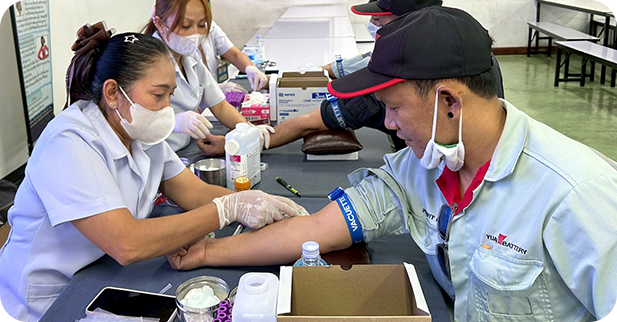
The Company is committed to fair, non-discriminatory compensation and welfare policies that are aligned with economic conditions. Emphasis is placed on developing employee potential, enhancing work efficiency, and ensuring occupational health, safety, and a safe working environment, free from operational accidents.
In the 2025 employee satisfaction and engagement survey, 307 employees participated in the assessment. The survey results indicated that the average job satisfaction score was 82%, while the average satisfaction with the working environment was 79%, reflecting a high level of satisfaction in both areas and showing an improvement compared to 2024. Employee engagement was rated at a moderate level, with an average score of 3.60, or 72%.
The Company will analyze the results and feedback to formulate strategies, review employee care measures, and enhance employee engagement and participation moving forward.





| Customer Satisfaction Aspects | Unit | 2022 | 2023 | 2024 | 2025 |
|---|---|---|---|---|---|
| 1. Batteries and packaging | % | 78 | 74 | 80 | 87 |
| 2. Sales | % | 85 | 85 | 85 | 90 |
| 3. Delivery | % | 77 | 76 | 80 | 84 |
| 4. Marketing and advertisements | % | 72 | 67 | 74 | 78 |
| 5. After-sales services | % | 73 | 73 | 78 | 85 |
| Average | % | 77 | 74 | 79 | 84 |
Remarks: 80% or above refers to "Excellent" 70-79% refers to "Good" 60-69% refers to "Moderate" 59% or below refers to "Need improvement"
Source: The Customer Service Department, Yuasa Battery (Thailand) PLC

The company, as a manufacturer and distributor of automotive and motorcycle batteries, conducts its business with social responsibility in order to minimize various impacts arising from its operations. It adheres to principles of transparency, accountability, ethics, respect for human rights, and focuses on the needs and expectations of stakeholders.
The company is committed to developing its battery manufacturing business in parallel with social responsibility, strictly complying with all legal and relevant regulatory requirements, as well as international best practices, in order to build a strong foundation for continuous and sustainable responsibility.