
Knowledge for car batteries

How to maintain the battery in flood conditions
Good tips for checking cars ... after the flood / drowning situation (electrical system)
- First, don't try to hurry to the engine. Cars that have just been removed from water or water are reduced from flooding. Engine Because the water in the engine makes the connecting rod with the valve push rod
- Do not put a bunch of lights to mount the engine. Cars that are newer than the 1989 or 1989 model will give the LA Turner, which is often referred to as the charger. And many electronic devices have been damaged in the car
- Before replacing the battery Or remove the battery to fill the light again and then use it Or can clearly say Connect the battery to the car again after the water has passed. Disconnect the fuse of the airbag system in order to not work up in this first phase. That the electrical circuit in the air bag system is grounded or shocked The air bag explodes like a work that can be used up just a thousand times.
- Normally when knowing that the car is drowning We should remove the power cord, lift the battery up high on the house first. If the battery is not drowning, it will run out of electricity before it can damage the short circuit current due to water. But when the water is dry, the circuit may be grounded When there is a current, short circuit, when Should immediately remove the battery cable as soon as the car is out of water If not, remove the batteries out of the way first Especially the car that accidentally dropped the water
- Now, when letting the device cycle dry Will release the fuse of the circuit that is confident before leaving, such as the airbag circuit, etc.
Battery inspection after flooding
- When the battery can be removed from the car, remove it immediately.
- Tighten the battery cover.
- Use detergent mixed water to clean the battery.
- Wipe dry with a dry cloth.
- Open the lid completely.
- See colors and distilled water levels in the battery.
- If distilled water is clear and in normal levels Bring the battery to compress the light.
- If distilled water is clear or opaque And the distilled water level is full Indicates that the battery has contaminated material inside should not be recycled To change the battery better
There are questions to ask. For car users who suffer from flooding problems
Best wishes From Yuasa Battery
Is it time to change the car battery?
- Test the condition of the car battery to see if it still works or not.
- If it is a water battery Must always be added to the battery Do not let the water dry.
- See how old it is. If more than 2 years old, the battery should be replaced.
- Changing the car battery should have a professional technician change. Should not change yourself if you are not yet an expert
- Choose car battery size To suit the car Which will range from small to large
- Choose the appropriate amp for the car. If the car does not use much power, such as opening the speakers, watching movies on a regular basis Using a small amp is enough.
- Suggest that if there is no time to take care of the car Should use dry batteries Because they do not have to wait to fill their own water, easy to use, convenient, but the price will be more expensive than water batteries
Car battery replacement That should at least change every 2 years because after that it will be time for the car battery. Began to deteriorate However, changing the car battery Or choosing a car battery Without knowledge Recommendations should be consulted with experts only.
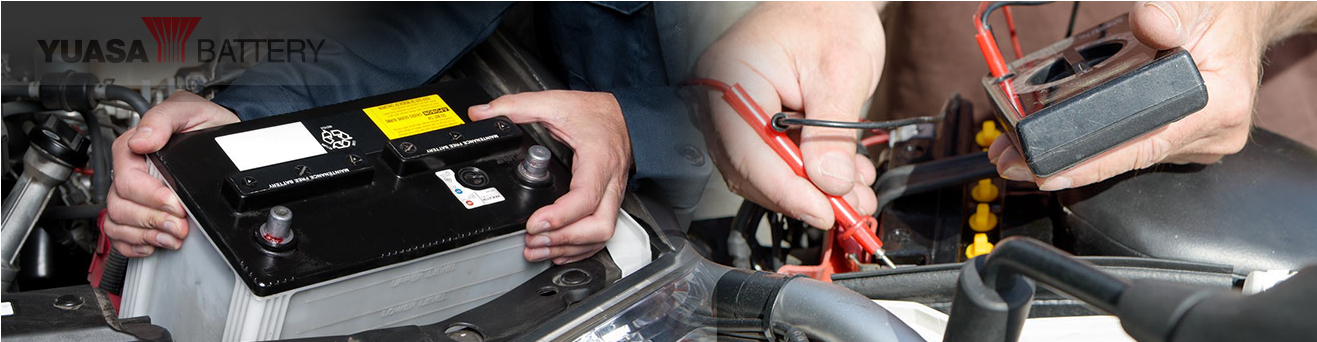
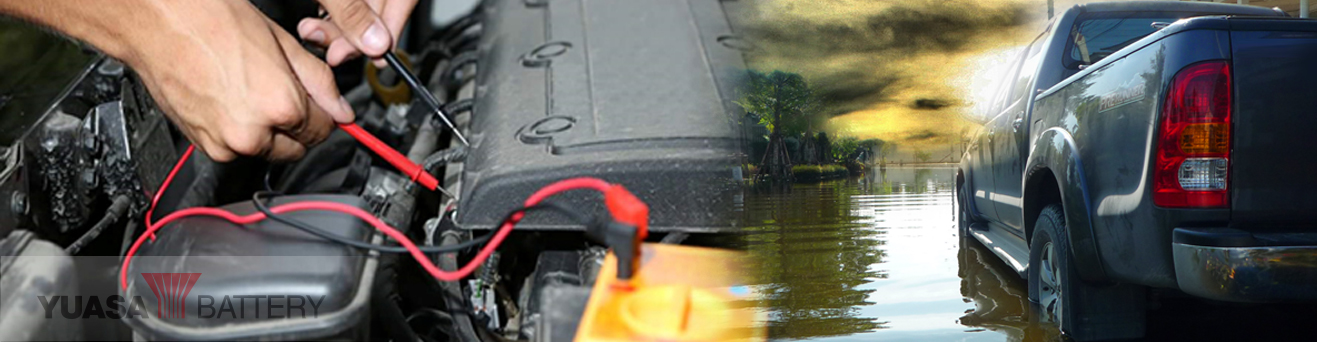
Knowledge for motorcycle batteries
A battery stores and supplies electrical energy to various systems in a vehicle, especially before the engine starts. It is a critical component that enables the vehicle to begin operation properly.
Functions of a Battery
1. Engine Starting
The battery supplies electrical current to the starter motor, which turns the engine to initiate operation. Electrical energy is converted into mechanical energy until the engine starts and runs independently.
2. Supplying Power to Electrical Devices
The battery provides electrical power to various components in the vehicle, such as lighting systems, signaling systems, and electronic devices—particularly when the engine is not yet running or when the power generation system is insufficient.
3. Maintaining Voltage Stability
The battery helps absorb and regulate voltage fluctuations within the electrical system, ensuring a stable power supply. This protects electrical components and electronic systems, allowing them to operate efficiently.
Types of Batteries
Batteries can be classified based on the type of electrolyte and their usage characteristics. Each type has distinct properties and limitations, as follows:
Classification by Electrolyte Type
Dry Cell: Uses a semi-solid or paste-like electrolyte, with no free liquid that could leak. It can operate in various orientations and is suitable for general portable devices.
Wet Cell (Storage Battery): Uses a liquid electrolyte and can be recharged and reused. A common example is the lead-acid battery used in cars and motorcycles.
Classification by Usage Characteristics
Primary Battery: A non-rechargeable battery that must be replaced once depleted. Examples include alkaline batteries and lithium batteries used in small electronic devices.
Secondary Battery: A rechargeable battery that can be used multiple times. Examples include lithium-ion batteries in mobile phones and computers, as well as batteries used in vehicles.
Secondary batteries can be found in both dry cell and wet cell forms. Common types include lead-acid batteries, lithium/lithium-ion batteries, and nickel-based batteries. Each type operates based on different chemical principles and is suited to different applications.
Working Principle of a Lead-Acid Battery
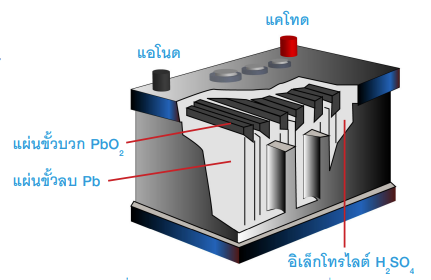
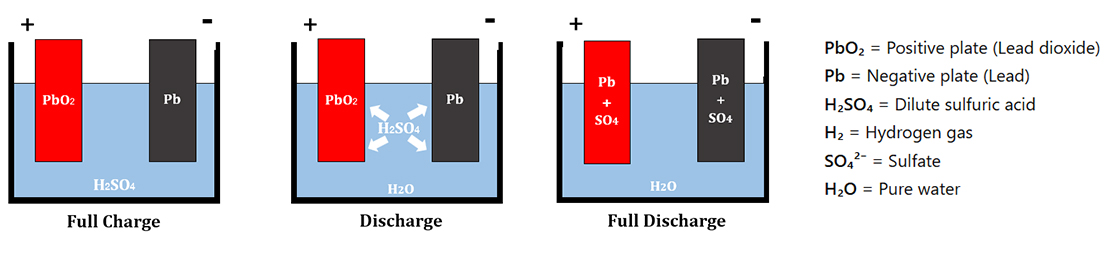
A Lead-Acid Battery typically consists of 6 cells, each producing about 2 volts, resulting in a total of approximately 12 volts. The electrodes are made of lead.During charging, the lead plate connected to the positive terminal reacts with the electrolyte, which is sulfuric acid (H₂SO₄). This reaction produces Pb²⁺ ions, which then combine with oxygen to form lead (IV) oxide (PbO₂), as represented by the chemical equation.
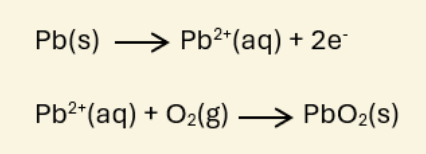
After that, the lead plate coated with PbO₂ acts as the anode, while the other lead plate acts as the cathode. The electrochemical reactions that occur during discharging (supplying electrical current) and charging are as follows:
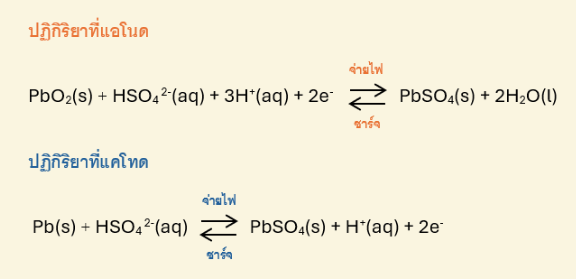
Chemical Reaction Principles of a Lead-Acid Battery
A motorcycle battery is the primary power source for the starting system and various electrical components, enabling the vehicle to operate efficiently.Today, AGM (Absorbent Glass Mat) batteries are widely used due to their durability, safety, maintenance-free design, and trusted performance by leading brands such as Yuasa.
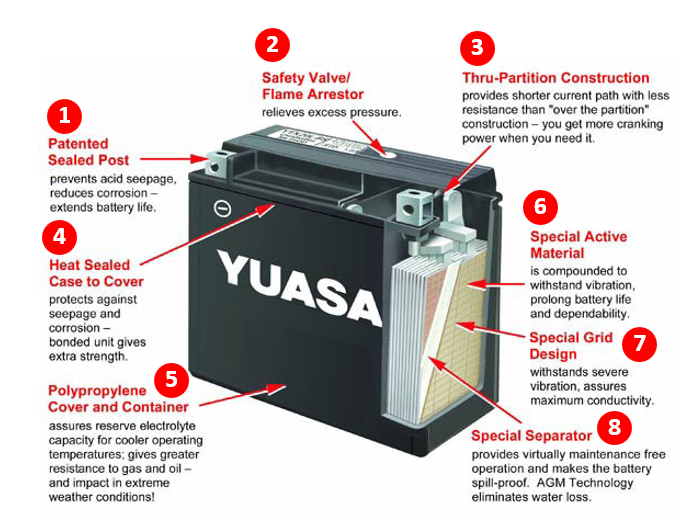
Features and Structure of an AGM Battery
1. Patented Sealed Terminals (Patented Sealed Post)
Prevent acid leakage, reduce corrosion, and extend battery life. They serve as the connection point between external devices and the battery, supporting high current flow without deformation.
2. Safety Valve / Flame Arrestor
The Safety Valve regulates internal pressure, preventing excessive buildup and reducing water loss. When pressure increases, the valve-regulated system releases excess pressure to avoid damage.
The Flame Arrestor prevents explosions caused by external sparks and internal gases during charging, while the sealing system prevents acid leakage that could corrode the motorcycle structure.
3. Thru-Partition Construction
Provides the shortest path for current flow, reducing internal resistance. This ensures high cranking power and consistent starting performance. It connects the plates in each cell, separating positive and negative terminals.
4. Heat-Sealed Case to Cover
The battery cover and container are fused together using high heat, forming a single solid unit. This prevents leakage and corrosion while enhancing strength and vibration resistance.
5. Polypropylene (PP) Cover and Container
Made from high-quality polypropylene plastic, lightweight yet strong. It is heat-resistant, impact-resistant, and does not absorb acid or oil. It also helps regulate temperature during operation, even in harsh environments.
6. Special Active Material
A specially formulated lead compound designed to improve vibration resistance, extend service life, and maintain consistent performance.
7. Special Grid Design
Manufactured using a grid casting process for superior strength. Designed to withstand high vibration and enhance electrical conductivity, ensuring strong and stable current output.
8. Special AGM Separator
High-quality glass fiber separators provide excellent electrical insulation, preventing short circuits between plates. With AGM technology, they absorb electrolyte efficiently, preventing leakage and spillage while improving internal stability and vibration resistance.
They are maintenance-free, requiring no water refilling throughout the battery’s lifespan.
Proper automotive battery maintenance helps extend its lifespan and reduces the risk of starting problems.Nowadays, most automotive batteries come in two types: Maintenance-Free (MF) and Conventional (wet cell). Each type requires slightly different care, but the key practices are as follows:
1. Check Electrolyte Level: For conventional (wet) batteries, check every 2–4 weeks or every 1,000 km. For maintenance-free batteries, check every 3–6 months or every 10,000 km. If the level is low, refill with distilled water. Do not exceed the maximum level, as this helps prolong battery life.
2. Clean Battery Terminals: If there is corrosion buildup, clean it using a brush or a cloth with warm water, then wipe dry. This helps prevent further corrosion and ensures good electrical conductivity, extending battery life.
3. Check Tightness of Terminals and Battery Hold-Down: Ensure that the terminals and mounting brackets are securely fastened to minimize vibration, which can shorten battery lifespan.
4. Inspect Charging System (Alternator): If the battery warning light appears on the dashboard, the engine is difficult to start, or the lights are dim, the alternator may be malfunctioning (overcharging or undercharging). It should be checked immediately to prevent battery damage.
5. Start the Vehicle Regularly: Leaving the vehicle unused for long periods can lead to self-discharge. Start the engine and let it run for about 15–20 minutes, 1–2 times per week, to allow the alternator to recharge the battery.6. Avoid Using Electrical Devices Without Starting the Engine: Avoid using headlights, audio systems, or other electrical devices for extended periods while the engine is off, as this may drain the battery and prevent the vehicle from starting.
Steps for Filling Electrolyte and Charging a Conventional Battery
1. Prepare the battery, required tools, and electrolyte with a specific gravity of **1.250 ± 0.01** in accordance with the standard. Wear protective gloves and safety goggles to prevent direct contact with the acid.
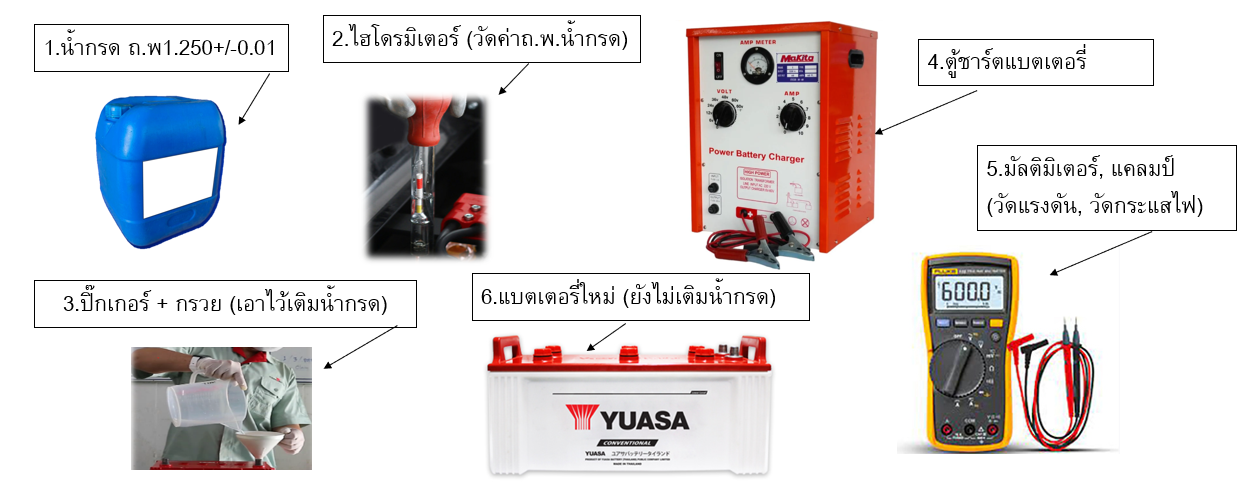
2. Open all vent caps. Slowly fill the electrolyte into each of the 6 cells until it reaches the specified UPPER LEVEL.
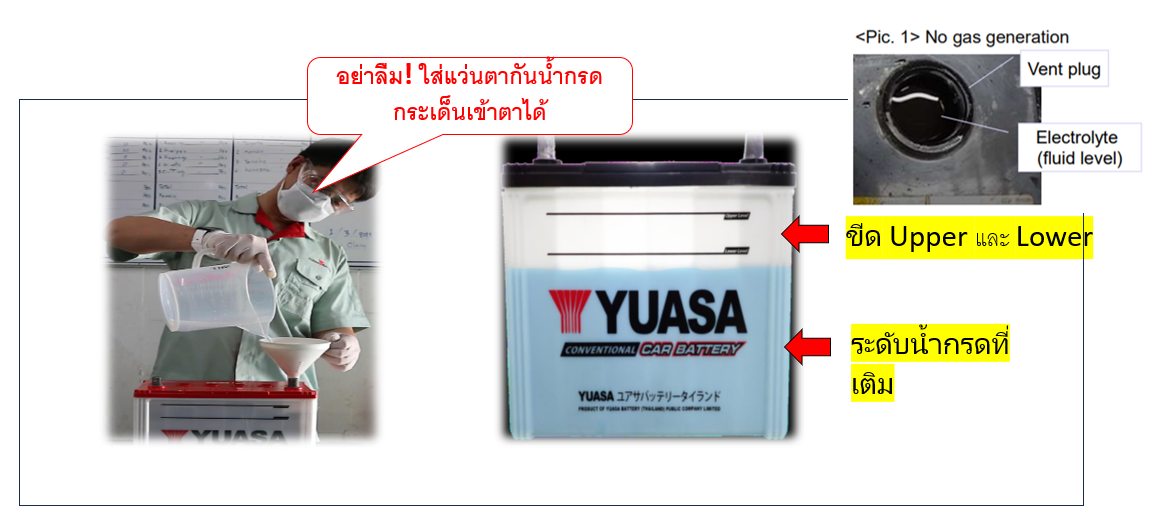
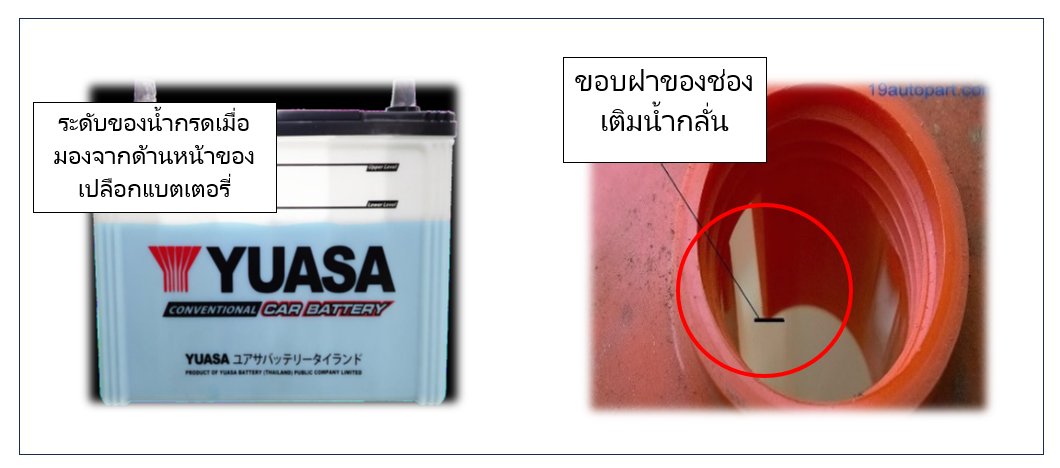
3. Let the battery stand for approximately 30 minutes to 1 hour. If the electrolyte level drops, refill until it reaches the bottom edge of the vent well. Do not overfill.
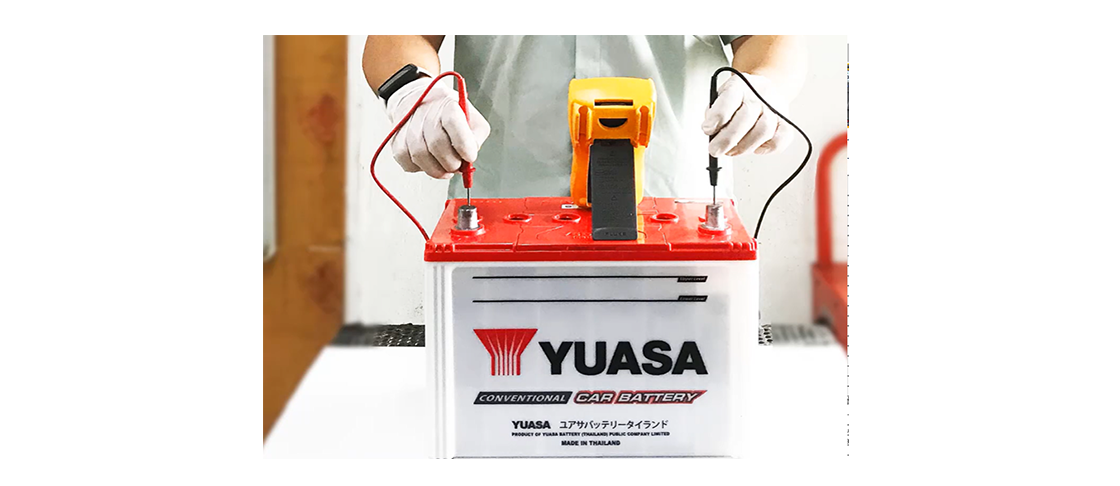
4. Check the battery voltage to set the appropriate charging parameters.4.1 Measure the voltage using a multimeter or clamp meter. Set the device to voltage mode, connect the positive (red) lead to the positive terminal and the negative (black) lead to the negative terminal.
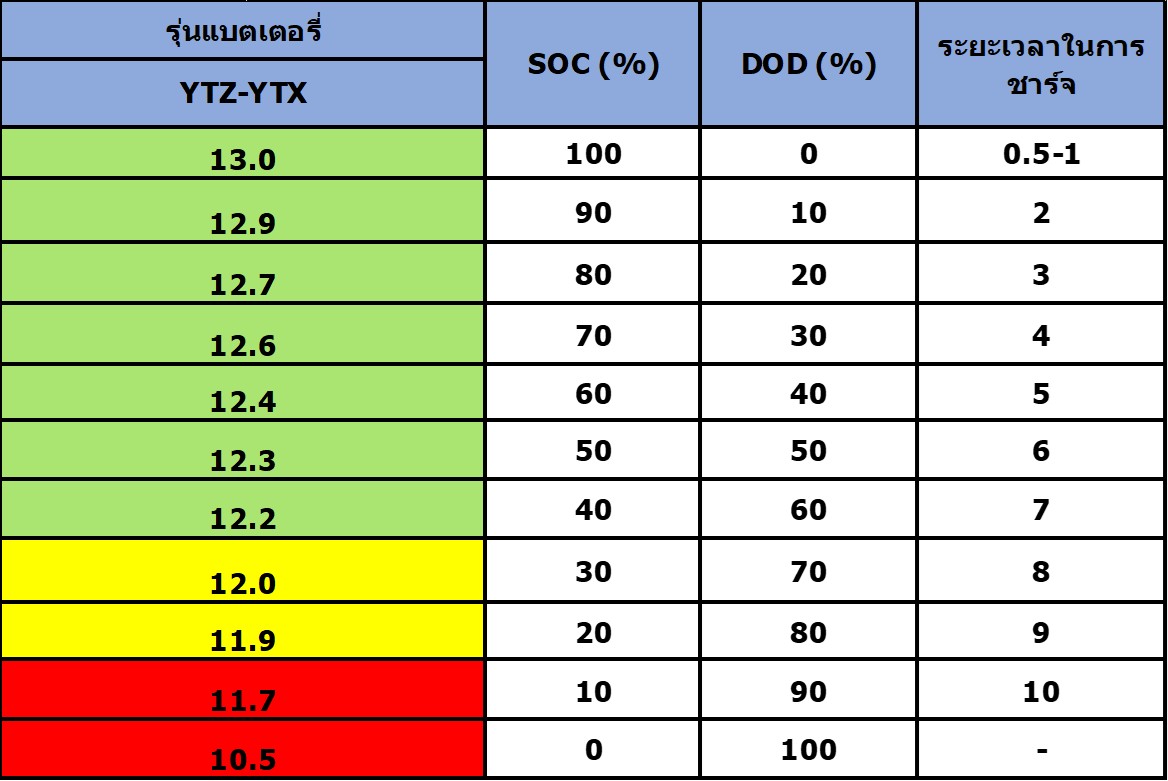
4.2 Compare the measured voltage to determine the appropriate charging time and current.
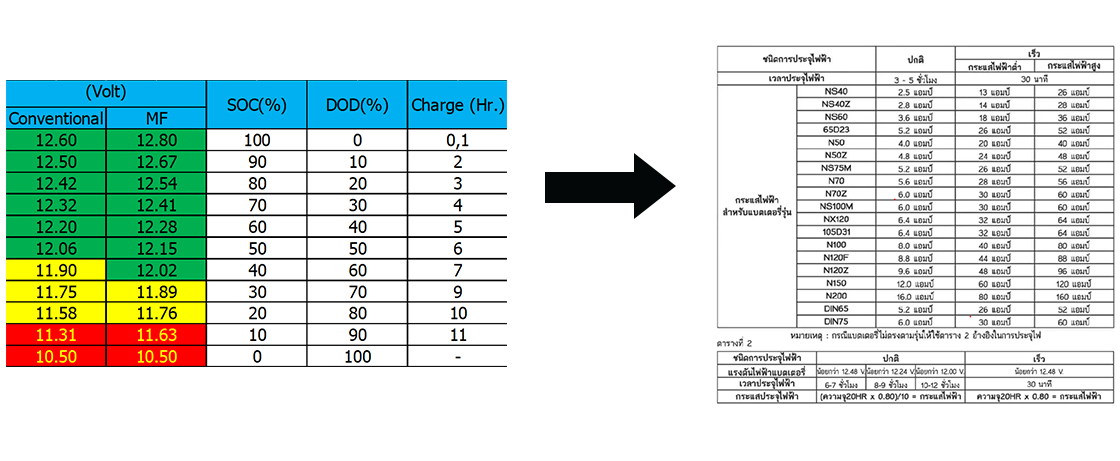
Voltage Comparison Table: Battery Status and Recharge Time for Automotive Battery
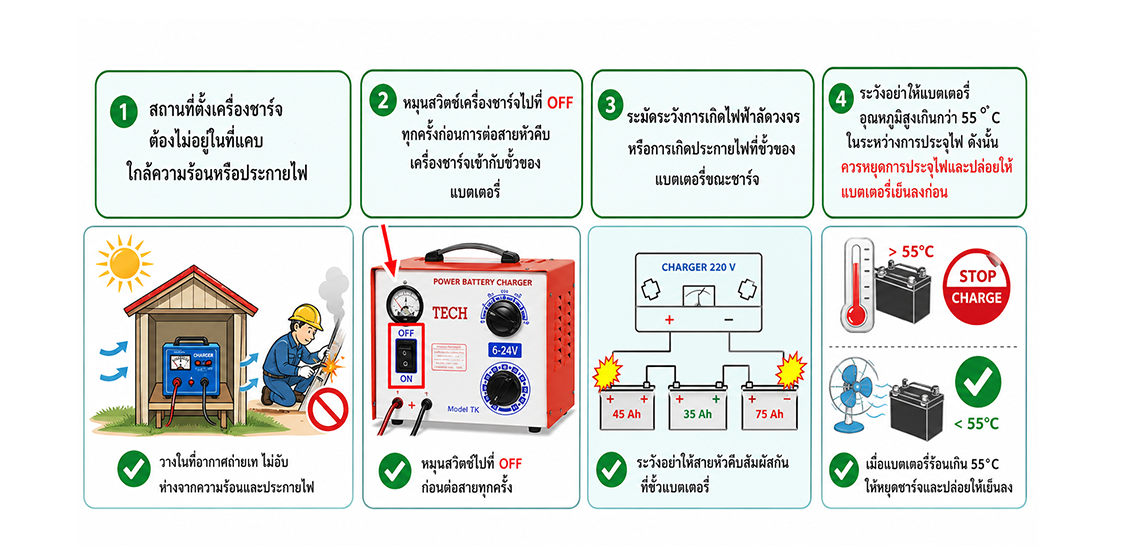
5. Charge the battery using an AC 220V charger.5.1 Connect the battery terminals to the charger correctly: positive (+) to positive and negative (–) to negative.
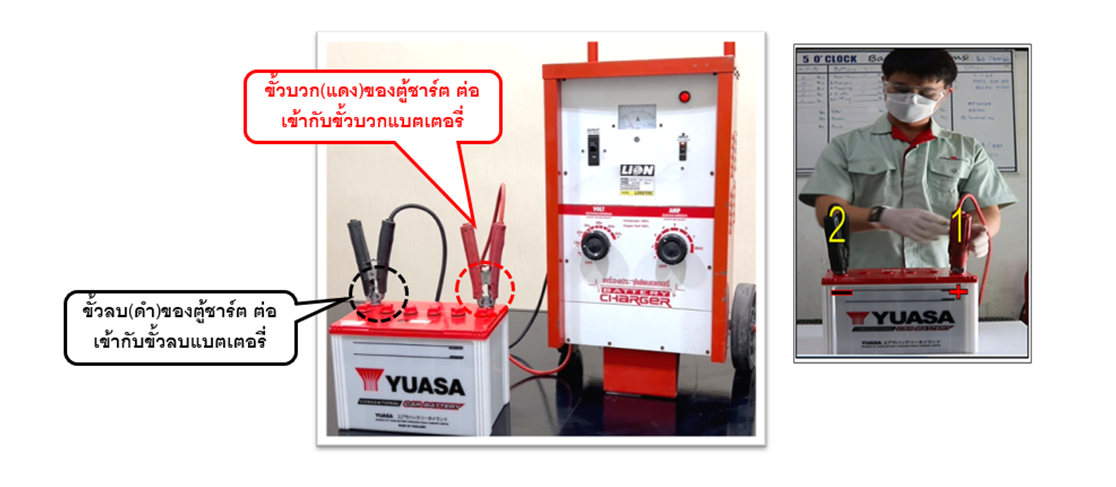
5.2 Turn the charger switch to the ON position and adjust the voltage and current according to the required charging settings.
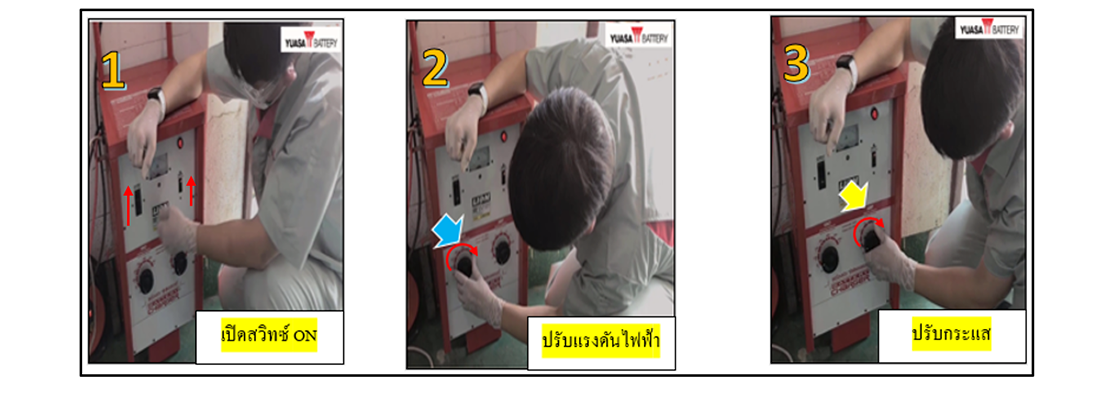
5.3 Monitor the charging current (amps) to ensure it matches or is close to the specified value, then start timing the charging process.
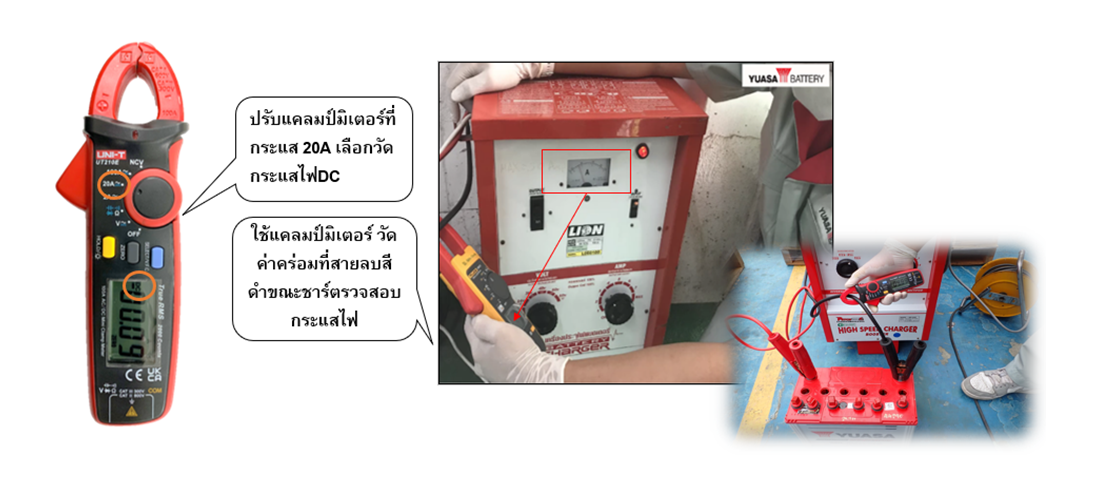
5.4 When the charging voltage rises above 16–18 volts or the required charging time is reached, set the voltage and current to OFF and switch off the charger.
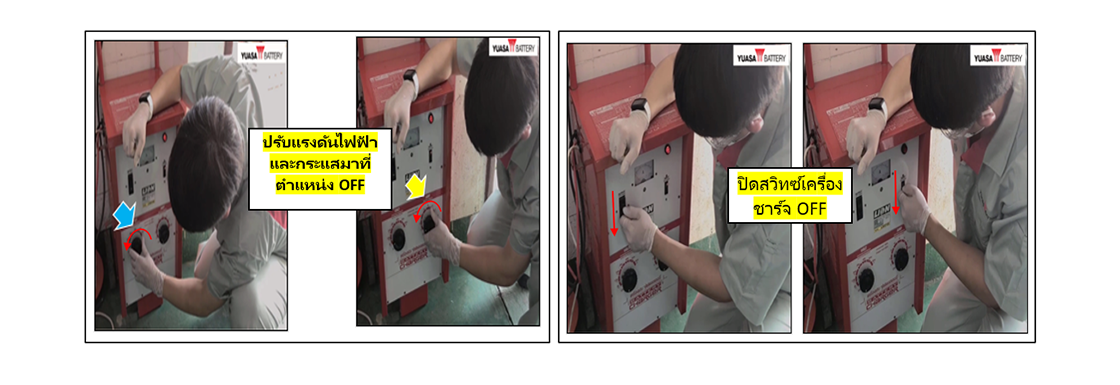
5.5 Allow the battery to rest for at least 30 minutes, then measure the voltage again. The reading should be within the standard range.
*Note: The standard charging current for a cabinet-type charger (AC 220V) for a single battery typically shows a charging voltage of approximately 17–18 volts when the battery is fully charged.
Precautions for Battery Charging
Steps for Filling Electrolyte and Charging a Separate-Type Motorcycle Battery
1. Prepare the battery and the electrolyte pack supplied with the battery.
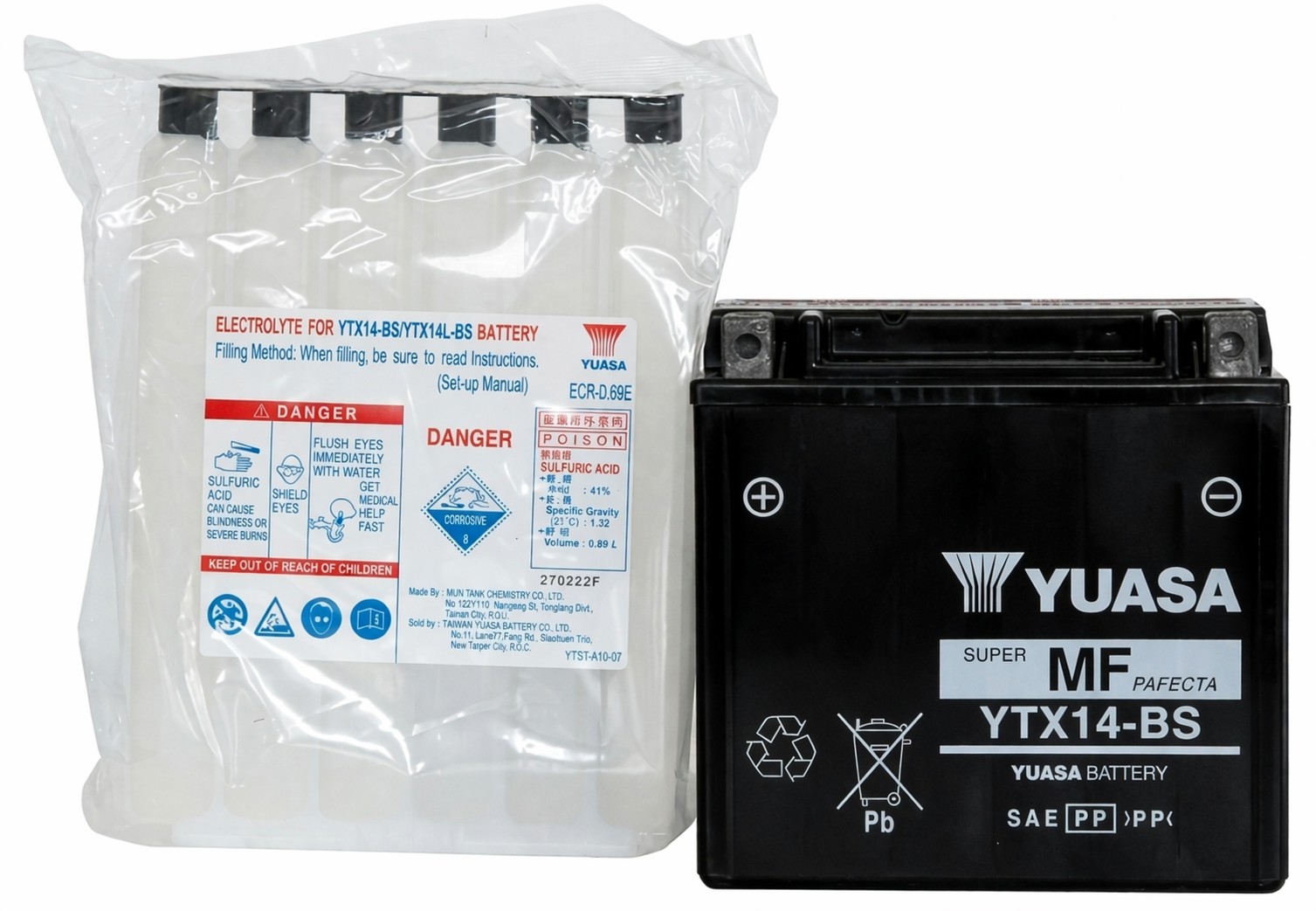
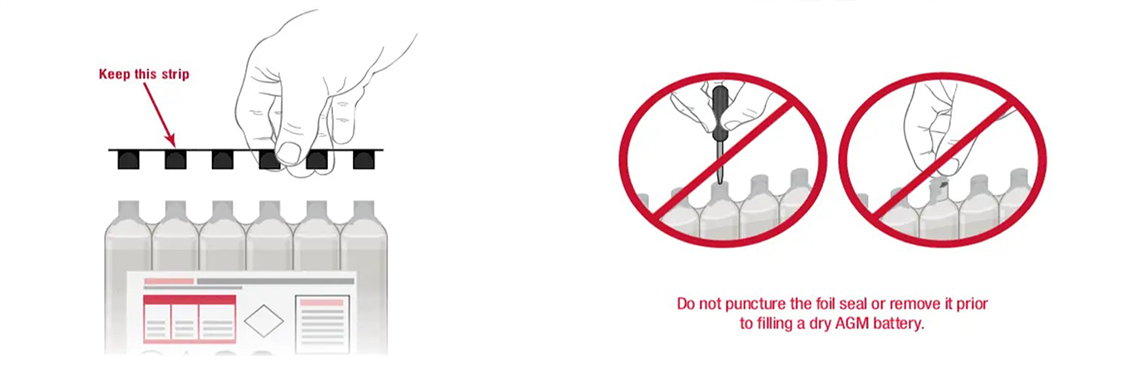
2. Remove the electrolyte container from the plastic bag. Then remove the sealing strip and keep it for sealing the battery later.For YTX dry-type batteries, use only the electrolyte container provided with the battery, as it contains the correct volume required, which directly affects battery life and performance.Note: Do not puncture or open the foil seal on the electrolyte container, and do not separate the container units.
3. Fill the electrolyte by placing the container upside down onto the filling ports, aligning it with all cells. Press down to break the foil seals.The electrolyte will automatically flow into the battery, and air bubbles may appear, which is normal.Caution: Ensure the container is placed upright and level at all times. Do not tilt the container during filling.
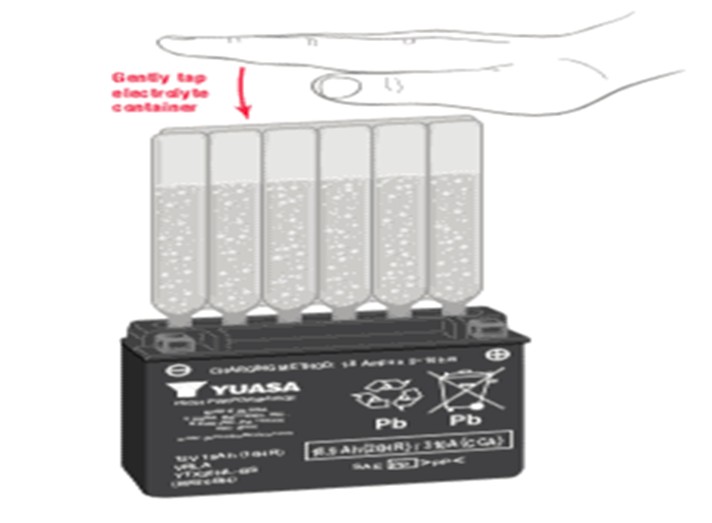
4. Check the electrolyte flow. Leave the container in place for at least 20 minutes or until it is completely empty.If there are no air bubbles or the electrolyte has not fully drained after 20 minutes, gently tap the container or battery to assist the flow.Caution: Do not remove the container until it is completely empty, as full filling is required for proper performance.
5. Carefully remove the empty electrolyte container. Then insert the sealing strip (removed earlier) into the filling ports and press firmly to ensure a tight seal on the top of the battery.
6. Let the battery stand after filling:- For batteries below 18 Ah: rest for 20–60 minutes- For batteries 18 Ah and above or high-performance models (marked “H”): rest for 1–2 hoursYou can check the Ah rating on the battery packaging.This resting period allows the electrolyte to fully absorb into the plates for optimal performance.
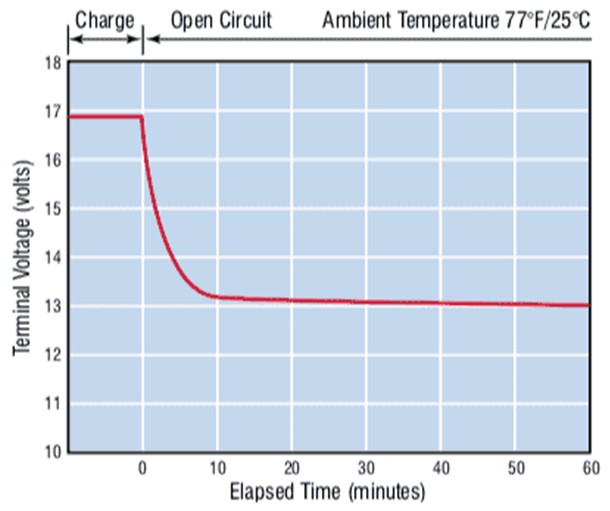
7. After filling, the battery will have approximately 75–80% charge. After resting as described in step 6, charge the battery to full capacity.Use a charger capable of charging at 12.8 volts or higher to ensure the battery is fully ready for use.
Charging MethodSTANDARD: Charge at approximately 10% of the battery capacity for 5–10 hours.QUICK:Charge at approximately 50% of the battery capacity for about 1 hour (suitable for new batteries).
Voltage Comparison Table: Battery Status and Recharge Time for Motorcycle Battery
Installing a motorcycle battery can be done by yourself. Following the correct steps will ensure safe operation and help extend the battery’s lifespan.
1. Remove the battery cover to access the battery.
2. Disconnect the negative (–) terminal first, then the positive (+) terminal for safety.
3. Remove the old battery from the motorcycle.
4. Clean the cable terminals to remove dirt and improve electrical conductivity.
5. Install the new motorcycle battery in the correct position.
6. Connect the positive (+) terminal first, then the negative (–) terminal.
7. Check that both terminals are securely tightened.8. Reinstall the battery cover. The battery is now ready for use.
A vehicle that won’t start is not always caused by the battery. Other issues in the electrical system or engine may also need to be checked.
1. Blown Fuse: Causes certain electrical systems to stop functioning.
2. Faulty Charging System (Regulator/Alternator): Prevents proper power supply to the system.
3. Electrical Short Circuit: Disrupts normal operation of the electrical system.
4. Loose Battery Terminals: Poor connections can restrict current flow.
5. Incorrect Battery Size: Using a battery that is not suitable for the vehicle may result in insufficient power.
6. Insufficient Charging / Long Inactivity: The battery may be undercharged or weakened after being unused for a long time.
7. Starter Motor Failure: Prevents the engine from cranking.
8. Electrical Leakage: Caused by improperly installed accessories or damaged wiring, leading to power drain.